
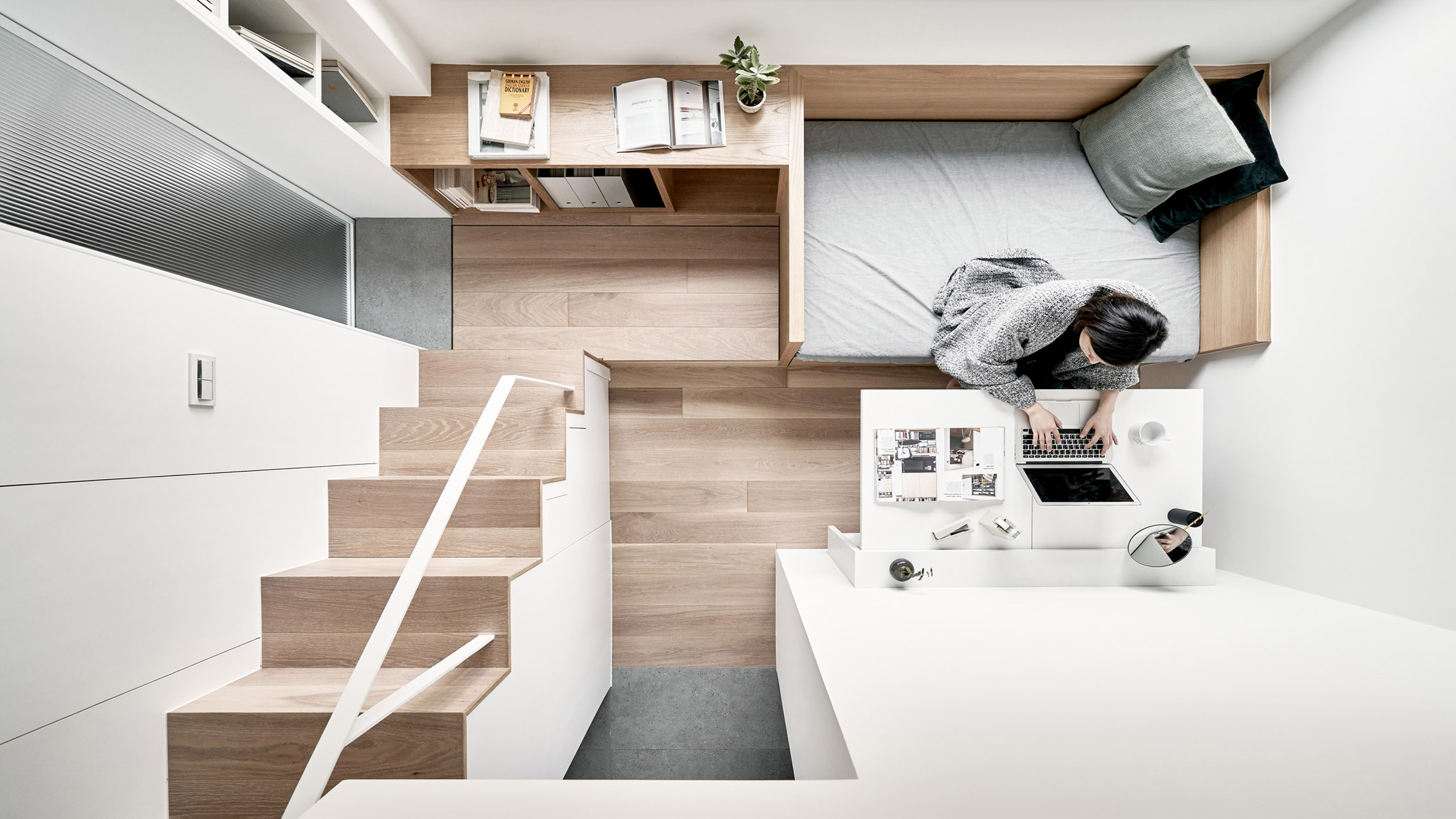
Micro-apartments have a floor they cannot go below, and that floor is set by accessibility standards. This is not a constraint to resist. It is the reason housing remains habitable for the population that actually exists.
Micro-apartments are like the fast food of the housing market. In certain situations they can be convenient, sometimes necessary, but normalising them as a standard creates pressure on space and quality across the entire market, whether you are an architect, landlord, or aspiring homeowner.
Accessible housing, on the other hand, operates with a strong commercial base precisely because it meets a standard that ensures long-term sustainability. For developers, it reduces the need for structural retrofits and removes the cost of correcting decisions that universal design would have answered from the outset. For buyers, it is the expected standard.
The Building Regulations have only reinforced these expectations. On a base level, housing in the UK must meet the requirements of Approved Document M (Access to and Use of Buildings, Volume 1), which operates across three tiers:
- M4(1) Visitable, the current default minimum requiring basic access.
- M4(2) Accessible and Adaptable, a higher “Lifetime Homes” equivalent standard with step-free access and the ability to adapt over time.
- M4(3) Wheelchair User Dwellings, a high-accessibility standard for wheelchair users.
The problem with micro-apartments and similar small new-build flats is that they only just satisfy the M4(1) standard, rather than meeting the higher tiers that better accommodate the way most of the UK population actually lives. This neglect of universal design principles is what explains the structural floor on unit size. It is not just a case of construction economics, like build costs not scaling efficiently below a certain footprint, or buyers leaving the smallest units on the shelves. The structural reason for the trend is accessibility.
The smallest new-build flats are not arbitrarily small. They are sitting on the minimum viable threshold defined by accessibility. Reducing them further is not just commercially unattractive, it becomes functionally unworkable.
As recently as October 2024, Volume 2 of Approved Document M set out higher standards for non-domestic buildings. These include the mandatory implementation of accessible Changing Places, enlarged WC cubicles for people with extra space needs, and clearer requirements for entrance design, ramps, corridors, and sanitary facilities. The National Planning Policy Framework (NPPF) reinforces the same direction of travel, pushing local authorities to ensure that housing across size, type, and tenure meets the needs of older people and disabled people. In practice, local authorities set their own targets above a combined 40% floor for M4(2) and M4(3) delivery, which means developers operating across multiple regions face inconsistent requirements depending on where they build.
That does not signify reduced expectations of the built environment. It signals a modern expectation that the micro-apartment trend cannot deliver. If people experience high levels of accessibility outside their homes, they will demand it inside them.
But despite this multi-faceted encouragement and obvious consumer demand, developers are still building most new homes only to the M4(1) minimum. Habinteg’s Forecast for Accessible Homes 2025, which analyses 311 English local plans, found that 75% of new homes in England will be built to the outdated M4(1) standard. Four in ten new homes planned over the next decade will meet neither M4(2) nor M4(3). And of all affordable homes planned, 8.9% are due to be M4(3) wheelchair user standard, while in the open market that figure drops to 3.3%. Some local authorities are not planning any open market wheelchair user homes at all.
Regional disparity makes the picture sharper. London plans one M4(2) home per 24 people. The North East plans one per 184. That is a 7.6 times variation across regions, and it sits directly underneath the postcode lottery developers already navigate.
The demand side reinforces the case. English Housing Survey data shows that around 400,000 wheelchair users in England are living in homes that are neither designed for nor adapted to their needs. The Hidden Housing Market research by Habinteg and Papworth Trust found that 1.8 million disabled people have an accessible housing need, 56% are home owners, and 39% are in the top half of the income distribution. The market that developers are not building for is not concentrated at the bottom of the income range. It is sitting in the income brackets that make accessible housing a commercially rational product.
This is also a market that extends well beyond disabled people alone. M4(2) and M4(3) homes serve older people, families with young children, and anyone whose mobility may change over time. Universal design is not a niche category. It is the design floor for the population that actually exists.
The cost case settles the argument. Habinteg’s analysis, drawing on Government figures commissioned in 2015 and updated for inflation, shows that a three-bedroom semi built to the accessible and adaptable M4(2) standard costs just £644 more in build cost than an M4(1) home. Habinteg’s 2024 cost analysis further showed that retrofitting an M4(1) home for accessibility can cost up to £27,000 more than building to M4(2) from the outset. £644 up front versus £27,000 later is the arithmetic that ends the argument.
The public purse case is even sharper. The Royal Borough of Greenwich has almost halved its waiting list for wheelchair-user council homes by ensuring 10% of new social homes built over the past five years are wheelchair accessible. The council estimates savings of up to £1m per 80 homes compared to retrofitting existing stock. Habinteg has also calculated that if just a quarter of the 400,000 wheelchair users in unsuitable homes needed one hour of care per day, the annual care cost would reach roughly £20m, enough alone to fund the additional build cost of 31,000 M4(2) homes per year. Developers and local authorities are on the same side of this argument once they see the numbers.
Retrofitting for accessibility is not a simple renovation either. It often requires structural alterations, specialised equipment, and custom labour to meet safety standards, frequently running into tens of thousands of pounds per dwelling. Building accessibly from the outset removes that downstream cost entirely.
The UK is not alone in this direction of travel. Across Ireland, continental Europe, and the United States, accessibility is becoming the regulatory baseline rather than the exception.
In Ireland, Technical Guidance Document M is the equivalent of Part M, and the National Housing Strategy for Disabled People 2022 to 2027 commits to 15% of new social housing allocations going to disabled households.
There is no single EU-wide equivalent to Part M, but EN 17210:2021 provides the harmonised technical standard for accessibility and usability of the built environment, and the European Accessibility Act mandated that the physical environment of services such as banking, retail, and transport be accessible by 28 June 2025. That deadline has now passed. National building codes in France, Germany, and other Member States all answer to these EU-level frameworks.
In the United States, the Fair Housing Amendments Act of 1988 governs accessible design in new multifamily dwellings of four or more units, and Section 504 of the Rehabilitation Act requires 5% of federally funded units to be accessible for mobility disabilities, plus an additional 2% for sensory disabilities. Yet 26% of Americans have a disability, and less than 5% of national housing supply provides accessible features. The gap between regulatory requirement and real-world need is wider in the US than in the UK.
The international cost evidence reinforces what the UK figures already show. Studies summarised by the Independent Living Institute, drawing on data from multiple jurisdictions, show that building accessibly from the outset adds between 0.006% and 0.5% of total build cost. The economic case is not a UK quirk. It is a global pattern.
Adopting universal design at the planning stage of a development means a larger pool of potential buyers and tenants, faster sales, and lower vacancies. Homes designed with accessibility in mind appeal to disabled buyers, older buyers, families with young children, and anyone planning to age in place. That is cost efficiency over time, and it is long-term asset value.
For architects, the same logic applies. Firms that demonstrate expertise in inclusive design differentiate themselves in a competitive market, win public sector and large-scale housing contracts, and reduce their clients’ retrofit liability over the lifetime of the asset.
The regulatory direction of travel is toward higher baselines, not lower. The cost argument has been settled by the data. Building accessibly from the outset is materially cheaper than retrofitting later, for the household, the developer, and the public purse.
For developers, planners, and housing providers, this is no longer a compliance question. It is a question of long-term asset performance.
If housing developers want a meaningful return on investment, the answer is not to exploit loopholes by converting office blocks into cramped micro-flats. It is to align with both market demand and regulatory expectations by embedding accessibility from the outset. An access statement from Direct Access supports this approach by helping to ensure compliance and manage risk, while contributing to the long-term viability and sustainability of development. It also provides a clear rationale for how a scheme can still deliver practical, inclusive homes when faced with constraints or design challenges.
Accessible housing is not a nice thing to have. It is the operational reality that will determine the long-term usability and commercial value of housing developments for decades to come.