
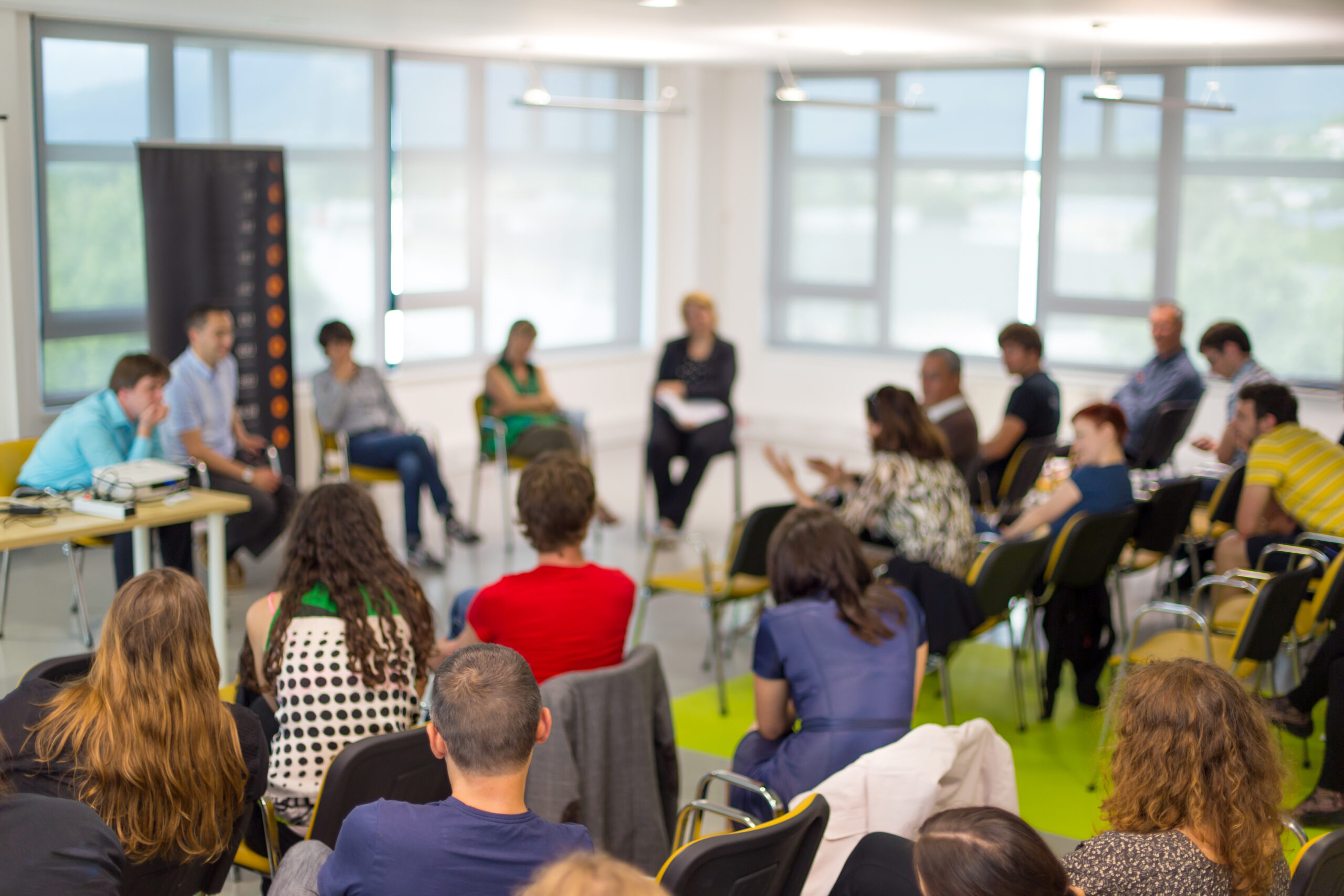
Focus groups have become a standard step in accessibility work, and the instinct behind them is sound. Bringing disabled people into the room early is better than designing in isolation and apologising afterwards.
The risk sits in what happens to the output. A room of opinions gets written up as findings. The findings become a specification. The specification becomes a building, a service or a website that a customer cannot use. When that customer brings a claim, the focus group is not the respondent. The organisation is.
Participants take on no legal duty by taking part. They are not named in proceedings. They do not hold the policy or the insurance. The organisation makes the decision, so the organisation defends it.
Start with the problem question
Most focus groups go wrong before anyone sits down, because nobody has written the problem in a single sentence.
“What do you think of this design?” produces preference. “Take us through the last time you tried to do this, tell us where it broke down, what you did next, and what it cost you in time, money or dignity” produces evidence.
Two questions frame a session that will hold up later:
What is the problem we are trying to solve, described as a point of failure in a real journey?
Does the proposed product or service remove that point of failure, for whom, and what does it do to everyone else’s journey in the process?
Opinion and user experience data are different inputs
Consider two statements from the same session.
“I would prefer the reception counter in a darker wood.”
“I could not see where the counter edge was against the floor, so I walked into it.”
The second describes a point of failure, is observable, and can be measured against the luminance contrast values in BS 8300. The first is taste.
Both are worth hearing. Only one carries weight when a decision is tested.
A working filter: can the statement be traced to a specific point in the journey, can it be observed or tested, and does it connect to an identifiable access requirement? If yes, treat it as evidence of a barrier. If no, treat it as preference. Preference remains legitimate research data, and it sits below duty and standard at the point a decision is made.
Reading what the comment is actually telling you
The harder skill is translating a comment into its effect on the user experience, then testing that against the problem statement.
A participant tells you the tactile map carries too many legends. The same participant found the lift and the accessible toilet unaided, on a first visit, in half the time it took them at the last venue they went to. The complaint is real, and what it reports is effort, or an unfamiliar convention, rather than failure. Act on it literally and you strip out the thing that produced the independence. The proper response is a question about density and hierarchy, because a tactile map that carries everything becomes unreadable under the fingers, and a map that carries too little leaves people to navigate by asking.
The reverse case is more common and more expensive. Someone tells you the visit was fine, and the record shows three wrong turns, two staff interventions and a task they never completed alone. People who are used to poor access rate it generously. Satisfaction is weak evidence of a working journey.
Four positions, four responses:
- Complaint with a successful outcome. Refine. Treat it as a question of density, hierarchy or convention rather than a trigger to redesign.
- Praise with a failed outcome. Redesign, and set the praise aside. This is where most organisations lose.
- Complaint with a failed outcome. Act. This is the straightforward case, and the only one most consultation processes catch.
- Praise with a successful outcome. Record why it worked and protect it, because this is exactly what gets stripped during value engineering.
Reaching that grid requires the session to capture outcome alongside comment. Record whether the person completed the task unaided, how long it took, how many wrong turns or staff interventions were required, and whether they would attempt it alone on a return visit. Without those, every input arrives as comment, and the list gets ranked by how forcefully each point was made.
Where one group’s fix becomes another group’s barrier
This is the part that creates liability, and it is rarely spotted in the room.
Removing kerbs to create a level surface helps wheelchair users and removes the detectable edge that blind and partially sighted people rely on to stay out of the carriageway.
Taking out tactile paving because a group finds it uncomfortable underfoot removes a safety warning at the top of a flight of stairs or the edge of a platform.
Turning off audio announcements to lower sensory load removes the primary information channel for blind passengers.
Bold colour blocking and strong patterning that helps some people with low vision can be disabling for some autistic people and people with migraine or vestibular conditions.
Moving service to an app to cut queueing excludes people without a smartphone, people with low digital confidence, and many people with cognitive impairments.
Quiet hours delivered by reducing staffing help some customers and withdraw assistance from those who depend on a person being there.
Every one of these came from a real consultation and none of them came from bad faith. They are single-condition answers to a multi-condition question. In almost all of them, the defensible outcome is parallel provision rather than substitution: keep the cue, add the alternative, give people a choice of route.
Mixed panels reduce this risk but they do not remove it. Two problems survive good recruitment.
The first is coverage. A group spanning four or five impairment types still leaves people out, and the duty is owed to every disabled customer rather than to the sample you managed to recruit.
The second is harder. A mixed room asks participants to trade their access needs against each other in public. Most people are generous in that situation, so the group reaches an agreement and someone quietly gives ground. The person who gave ground is rarely the person who brings the claim.
Arbitrating between conflicting access needs is the organisation’s job, resolved against the standards and by providing both options wherever both are possible. Handing that decision to the room looks like listening and functions as an abdication.
Weighing opinion against standards and obligations
Inputs into an accessibility decision sit in an order of authority, and the order matters when a decision is challenged. The order describes what can override what, rather than which input is most valuable.
Legal duty comes first. Under the Equality Act 2010, service providers owe an anticipatory duty to make reasonable adjustments. It is owed to disabled people at large, before any individual arrives, and it includes the provision of auxiliary aids. Public bodies carry the Public Sector Equality Duty on top of that. Public sector websites and apps carry the 2018 accessibility regulations.
Technical standards and guidance come second. BS 8300 parts 1 and 2, Approved Document M, PAS 6463 for neurodivergent users, WCAG 2.2 for digital. Most of these carry the status of recommendation or statutory guidance rather than law in their own right. They hold their position because they are the benchmark against which reasonableness is judged, and because they encode evidence that has already been gathered, tested and codified. Meeting them is a floor rather than a ceiling.
User evidence comes third, and it is powerful in that position. It shapes choices inside the envelope set by duty and standard, prioritises what gets fixed first, surfaces barriers the standards have yet to catch up with, and tests whether a technically compliant solution works for a human being on a wet Tuesday. A design can meet every applicable standard and still fail the person using it, and user evidence is the only thing that will tell you so.
What a focus group cannot do is vote the first two levels down. If a group tells you the induction loop is unnecessary, the organisation’s duty to address the substantial disadvantage experienced by people who need hearing support is unchanged. If a group is relaxed about a step, the step is still a barrier to the customer who was not in the room.
“Disabled people told us to do it” carries very little weight when the claimant in front of you was not represented in that group, and less still when the outcome falls short of a published standard. The organisation cannot discharge a duty owed to disabled people generally by taking the average view of one room.
When a focus group is the right tool
Use one to map real journeys end to end, to surface barriers that surveys miss, to test a compliant design in practice, to prioritise a fix list by genuine impact, to co-produce policy and staff training, and to understand what people do when your service fails them.
Use something else to settle a technical specification, to resolve conflicting access needs, to sign off compliance, to decide whether to do something you are already required to do, or in place of an audit.
How to run one so the output survives scrutiny
- Write the problem question first and share it with participants in advance.
- Recruit across impairment types, including cognitive and neurodivergent participants, and across intersections: older disabled people, disabled parents, people with more than one impairment.
- Run one-to-one sessions alongside the group. Some people will not speak in a room. Some need BSL interpretation, some need processing time, and a group format quietly filters both out.
- Pay participants. Unpaid consultation skews your sample towards people who can afford to take part.
- Ask about journeys rather than designs. Record the barrier, the point of failure, the workaround people used, and what it cost them.
- Have someone in the room who can convert lived experience into a technical requirement while the conversation is live, and who can say out loud when a proposed fix would create a barrier for a group that is not present.
- Never close on a vote. Log conflicts as conflicts and resolve them against standards and parallel provision.
- Write up what you did with every input, including what you set aside and why. That record is the document that defends the decision.
Who is in the room, and what they know
Lived experience on its own is testimony, and testimony is valuable. Lived experience held by a qualified professional becomes analysis, and analysis is what protects the organisation acting on it.
At Direct Access, disabled people are the consultants. They come to a project as qualified and experienced professionals whose technical knowledge runs across disability, sectors and user journeys, rather than as a source of commentary on their own impairment. Their authority extends a long way past their own diagnosis.
In practice that means a consultant with a visual impairment holds the technical knowledge to analyse a mobility user’s journey and identify where a proposed change creates a hazard. A Deaf consultant carries cross-sector expertise in how the Equality Act applies to people with cognitive impairments. That capability comes from professional qualification and years of delivery alongside lived experience, and assembling a focus group does not create it.
The company was founded by disabled people in 2004 and has been run by disabled people ever since, and over 80% of our staff are disabled. Across the team are NRAC-registered consultants, IAAP-certified practitioners and architectural designers, bringing more than two decades of corporate delivery across public buildings, heritage, retail, sporting and entertainment venues, and transport in its full range, from rail and aviation to roads, ticketing and interchange, on three continents.
That combination is what turns a session into evidence. It is how we ran the user experience work and focus groups on ticketing and point of sale for INDRA’s integrated road and rail ticketing programme in Ireland, and how we contributed to Starbucks’ Inclusive Design Framework.
Five questions before your next focus group
- Have we written the problem down as a point of failure, in one sentence?
- Who is missing from this room, and whose journey could our decision damage?
- Which statements can we trace to a failure, and which are preference?
- Does anything we are proposing sit below a legal duty or a published standard?
- If a customer brings a claim in two years, what is the document that shows how we reached this decision?
- If the answers are thin, the focus group has produced a consultation exercise. The work of turning it into a defensible decision is still ahead of you.
The method should follow the problem
Focus groups are one intervention among several, and they are frequently reached for first. Depending on the problem, the right process may be co-design, one-to-one user research, technical appraisal, an access audit, or consultancy from a team that already holds the lived experience and the professional qualification in the same people. Bring that expertise in early enough and a focus group is sometimes unnecessary, because the questions it would have asked have already been answered by people qualified to answer them.
Direct Access helps organisations work out what evidence they actually need before consultation begins, and turn that evidence into decisions that hold across different and competing access requirements.