
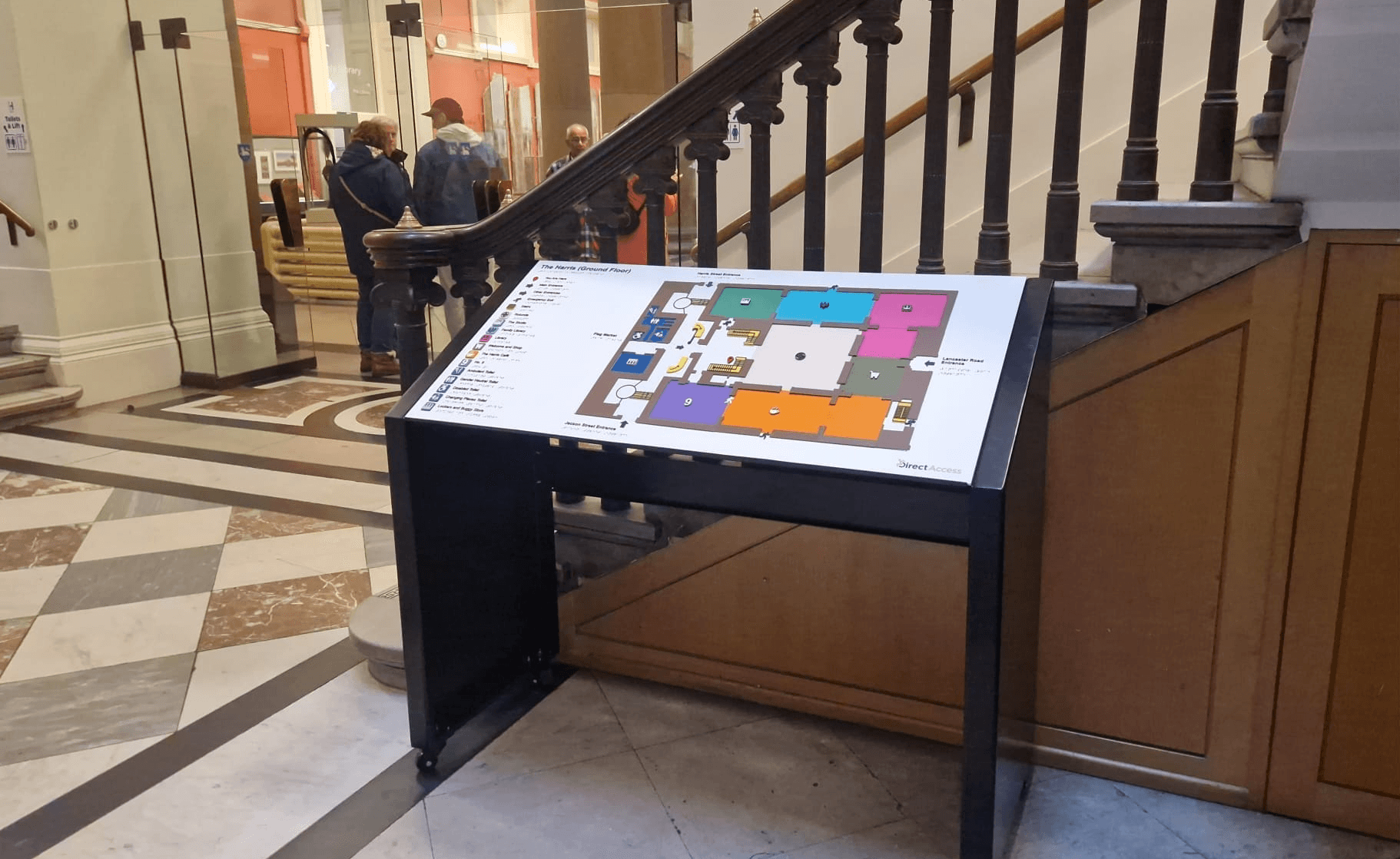
As part of The Harris Museum’s ongoing commitment to accessibility and inclusion, the museum identified a need to improve wayfinding for visitors with visual impairments and other disabilities. The objective for our Accessible Media & Materials team was to provide an intuitive navigation system that enabled greater independence, while also aligning with recognised accessibility standards.
Direct Access focused on delivering a tactile mapping solution that would integrate seamlessly into the museum environment while offering clear, practical guidance for users with a range of needs.
Navigating a multi-level heritage building presents inherent challenges, particularly for visitors who are blind or partially sighted. The Harris Museum’s layout includes a variety of galleries, open spaces, and transitional areas that can be difficult to interpret without visual cues. Existing signage systems were primarily visual, creating barriers to independent exploration.
A considered, two-part tactile wayfinding system was designed and implemented to address these challenges.
On the ground floor, a permanent tactile map board was installed at a key decision-making point within the museum. This board was developed to provide an immediate and comprehensive overview of the space. Raised tactile elements clearly define walls, routes, and important locations, allowing users to build a mental map of the environment through touch. Braille labeling was embedded directly into the design, ensuring that essential information is accessible to blind users.
Particular attention was given to visual accessibility. The board incorporates high colour contrast to support partially sighted visitors and complies with recommended accessibility standards. All text is presented in a sans serif typeface at an appropriate size to maximise legibility. A clearly structured key accompanies the map, enabling users to easily interpret symbols and navigate with confidence.
For the upper floors, swell paper tactile maps were introduced as a flexible and accessible solution. These maps can be made available to visitors as needed, offering a portable wayfinding aid that mirrors the design and symbology of the ground floor board. This consistency ensures that users do not need to relearn navigation cues as they move through the building. The swell paper format also allows for detailed tactile reproduction while remaining lightweight and easy to handle.
The introduction of tactile mapping at the Harris Museum has transformed the way visitors with visual impairments engage with the space. The new system enables greater independence, allowing users to navigate the building with confidence and reduced reliance on staff assistance.