
It is now 2026, and given our world’s reliance on digital platforms for everything from banking to shopping, digital entertainment is often marketed as more inclusive than ever. Watch any advertisement for a major company such as Microsoft, Google, or Apple, and you will notice a clean, inoffensive, and inclusive presentation that, at face value, appears to prioritise the consumer, whoever that consumer might be. So why is it that digital entertainment companies are still missing the mark when it comes to making their content truly inclusive for the hundreds of millions of people who use it?
Undoubtedly, with the corporatisation of the internet, accessibility in film, television, and gaming has made significant progress. Never before has it been so easy to access a wide range of titles. However, while progress has been made in terms of availability, accessibility is still too often treated as an optional extra, a marketing bullet point, or a cost-saving compromise rather than a core design requirement.
One of the most common accessibility tools in digital entertainment, and something that Direct Access frequently recommends in website, digital, and social media audits, is the provision of subtitles and captions, which are integral to communicating key information to deaf and hard-of-hearing consumers. Yet major streaming platforms such as YouTube, Netflix, Amazon Prime Video, and Disney+ increasingly rely on auto-generated subtitles powered by speech recognition rather than professionally created captions. While it is difficult to determine whether this is due to negligence or cost-cutting, it is likely the latter. With a constant influx of content added to compete with rivals, accessibility often falls by the wayside, with professional subtitlers rarely hired to ensure every line of dialogue or audio cue is communicated clearly. Many subtitles do not change colour to differentiate multiple speakers, leaving finer details of conversation lost.
While auto-captioning has expanded access in sheer volume, errors in names, accents, technical language, and emotional tone are common. Music cues, background sounds, and speaker identification are frequently missing or incorrect. This approach reduces production costs, but it places the burden of interpretation on disabled viewers, effectively offering a worse version of the content.
Live broadcasts and streamed events also rely heavily on automated captions, despite long-standing evidence that human-edited captions provide significantly better access. The result is accessibility that exists in theory but fails in practice for many users.
Gaming is currently experiencing a meteoric rise in popularity. Growing exponentially during the pandemic, it is now the most popular form of traditional media. It is estimated that there are approximately 2.7–3 billion gamers worldwide.
The games industry often highlights accessibility breakthroughs, yet many high-profile titles remain inaccessible to large groups of disabled players. Several major modern releases rely almost entirely on visual cues, small UI elements, colour-based indicators, and complex visual environments without adequate audio description or screen reader support.
A few members of the Direct Access team are game enthusiasts. Our visually impaired accessible media lead, Craig, prefers games like Until Dawn and Subnautica, which emphasise audio-based mechanics, such as the former’s hide-and-seek gameplay loop. Personally, I enjoy relaxing, cosy games that do not feature intense gameplay as these are often inherently simple and more accessible as a result. An example is Stardew Valley, which includes subtitles, text size adjustments, and customisable controls. There is also a large modding community adding further accessibility improvements, such as screen reader support and colourblind-friendly palettes.
Most games, however, even when subtitles are present, often fail to describe environmental information, enemy positioning, or visual storytelling elements critical to gameplay. Even the largest tentpole games still assume players can manage complex controller inputs, rapid button combinations, or sustained physical interaction. Titles such as Elden Ring and Baldur’s Gate 3 have been widely criticised for lacking navigational audio cues, menu narration, or meaningful non-visual feedback, making them extremely difficult or impossible to play without sight.
Games that require precise timing, button mashing, or simultaneous inputs, most common in action, sports, and fighting genres will frequently launch without fully remappable controls or support for alternative input devices. Although customisable controls are gradually becoming more common as a “quality of life” improvement, there is still considerable progress to be made.
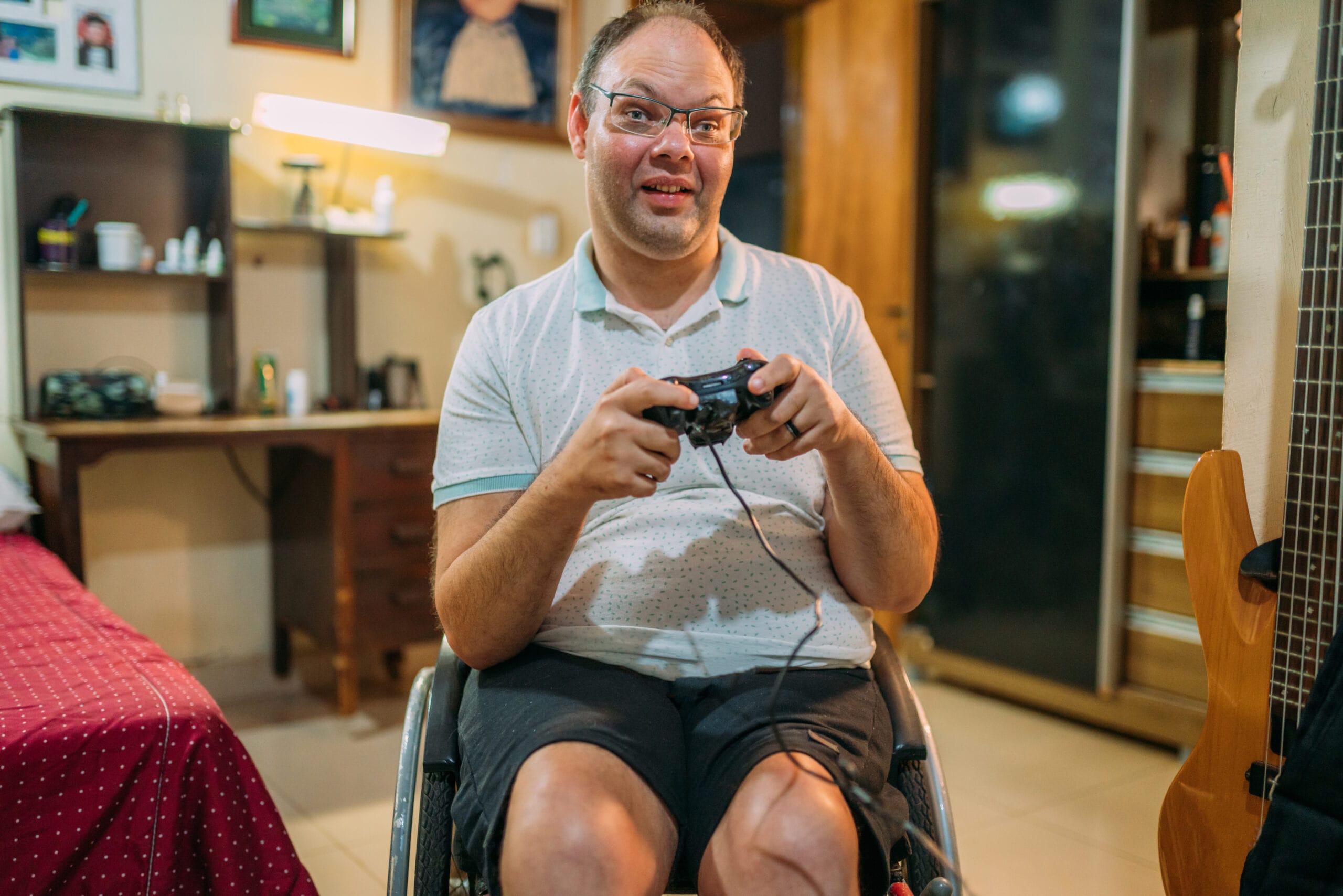
Adaptive controllers, such as the Xbox Adaptive Controller and various independent options (some of which we have discussed on this blog), provide a certain level of accessibility for mobility-impaired gamers. However, their effectiveness is limited when games themselves are not designed to accommodate different physical needs.
Hearing-impaired players are often disadvantaged by games that omit critical audio cues, such as approaching enemies, environmental changes, or directional sound. Outside single-player experiences, multiplayer gaming is a frequent social activity, particularly for younger players. Yet multiplayer games frequently rely on voice chat without robust text or visual alternatives, effectively excluding deaf players from core social and cooperative elements.
Beyond gaming, accessibility gaps exist across the broader digital entertainment landscape. Examples include:
Live events and streaming premieres that launch without captions, or with delayed and inaccurate automated captions, excluding deaf audiences from shared cultural moments.
Virtual reality (VR) experiences that remain largely inaccessible to visually impaired users and many mobility-impaired players due to reliance on motion tracking and physical movement. Some neurodivergent users may also struggle with overstimulation or the heavy reliance on spatial awareness and mobility.
Social media video content, including short-form platforms, that often lacks captions entirely or relies on creators to add them manually, resulting in inconsistent access. Sign language options are rarely provided, despite being recognised as an official language in the UK.
Digital ticketing systems, apps, and platforms tied to entertainment venues that frequently fail basic screen reader compatibility, preventing disabled users from accessing content they have paid for.
Across digital entertainment, the same pattern repeats. Accessibility features are often added late, automated to save money, or limited to the most visible impairments. Disabled users are expected to adapt to systems not built with them in mind, rather than being considered from the outset.
Where accessibility succeeds, it is usually because disabled people within game-focused focus groups or accessibility consultants like Direct Access—were involved in testing and design, allowing innovations to be integrated effectively. Where it fails, access is often treated as a compliance exercise rather than a creative or ethical responsibility.
An estimated three billion people worldwide regularly play video games, and the global games industry is thought to be worth roughly twice as much as the film and music industries combined. In the UK, the sector employs around 76,000 people and contributes approximately £6 billion a year to the economy.
The Association for UK Interactive Entertainment (UKIE), the trade body for the UK games industry, states that the sector takes accessibility seriously and has invested millions of pounds in accessible design. It acknowledges that, despite progress, blind and partially sighted players continue to face barriers, and further improvements are needed.
There are also positive examples. UKIE notes that new games are increasingly released with accessibility considered as a core part of design. Titles such as Assassin’s Creed Shadows, EA Sports FC 26, and DOOM: The Dark Ages have gone beyond basic requirements and raised expectations across the industry. However, more needs to be done to improve digital accessibility—not just in entertainment, but across all businesses and organisations offering information in digital formats.
Direct Access’ accessible media department can provide audits of digitally provided information, including websites, social media, and documentation.
A final point to consider: approximately 250 million gamers worldwide identify as visually impaired, which should position accessibility as both a significant commercial opportunity and goal within the gaming industry. Of those 250 million, many are likely to engage with social media, YouTube, or educational websites. This is in addition to the millions of other disabled individuals who are not gamers but still rely on digital platforms.