
As societies become increasingly digital and interconnected, the presentation and delivery of media plays an ever more crucial role in shaping public understanding of accessibility; because how disability is catered for and portrayed through media directly influences public attitudes, policy debates, and societal norms. For the 1.3 billion people with disabilities on our planet, equitable access to information is fundamental to exercising the right to freedom of expression and participation in society on an equal basis.
Across two decades at Direct Access, we have developed a reputation for directly supporting organisations in meeting their responsibilities, by providing practical guidance, audits, and implementation support to embed accessibility and disability equality across digital platforms, content production, and organisational practices.
However, aside from promotion of best practice and social responsibility, which everyone can understand and appreciate on a human level, we also teach our clients that the implementation of accessible media is hugely lucrative for our clients in ways that are not always understood – which is the other reason we offer our accessible media as a service.
For instance, an accessible website might ensure that digital content can be used by people with a wide range of access needs, including screen reader users, people with low vision, neurodivergent users, and those with limited mobility. But for businesses, it leads to higher engagement, improved conversion rates, and reduced bounce rates, while also helping businesses meet legal and regulatory requirements. Accessible websites are also easier to navigate, load faster, perform better in search engines, and reach a wider audience.
When it comes to physical media, offering Easy Read materials present information in a clear, simple format using plain language and supportive visuals/icons. They are particularly valuable for people with intellectual disabilities, cognitive impairments, low literacy, or those for whom the primary language is not their first. But for businesses that go out of their way to provide it, Easy Read improves comprehension, reduces misunderstandings, and increases customer confidence, resulting in smoother interactions, fewer errors, and stronger customer relationships.
Beyond customers, businesses who are obligated to employ those with intellectual disabilities (or for whom English is not their first language) also benefit, as it allows them to meet their obligations for offering reasonable adjustments.
For businesses that offer brochures, leaflets, menus, contracts, safety information, or instructions, having Braille documentation to hand ensures that critical information is readily accessible to braille users (many of which are registered blind). For businesses, this demonstrates a strong commitment to inclusion, enables independent access to information, and again, allows them to meet accessibility obligations while building trust with customers and stakeholders.
In the realm of video tutorials, entertainment, social media, and advertising; accessible features such as captions, transcripts, audio descriptions, and clear navigation not only promote inclusion but also expand audience reach, improve search engine performance, and increase engagement.
Understanding that prioritising accessibility allow organisations to unlock new markets, strengthen brand reputation, and improve long-term sustainability are key to understanding the value of our accessible media products. Going beyond legal accessibility standards designed by committee, we develop products based on lived experience as a team of disabled people, allowing our products to be built to last in the long term.
Each product and service of our accessible media division is crafted with a human rights based approach that centers on equality and dignity, using accurate, respectful, and current language, avoiding stereotypes and sensationalism, and focuses on real societal and environmental barriers, not just individual impairments.
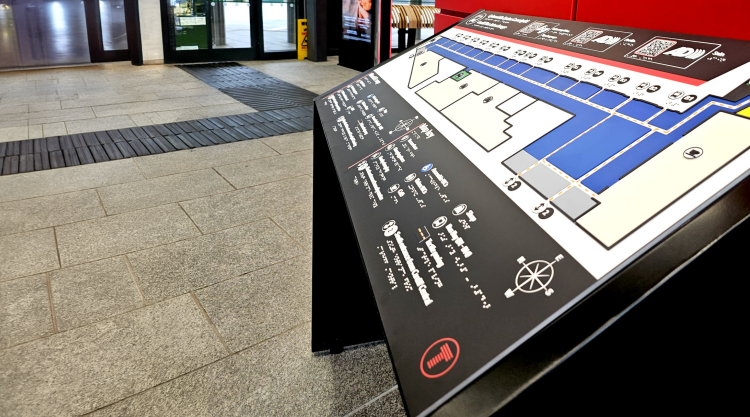
In addition to accessible video solutions such as captions, transcripts, and audio descriptions, Direct Access also designs and produces tactile map boards, portable mini-maps, and braille materials that provide meaningful access for people who are blind or have low vision. These products transform spaces, exhibitions, public venues, and information points into inclusive environments by making wayfinding and information independently accessible. From museums to expositions to train stations, our signature product; the Tactile Map Board, has been a particular favourite of our customers.
Beyond implementation of approriately contrasted colours, braille, and a key incorporating universally recognised symbols, we can also print QR codes on maps linking to bespoke audio descriptions, providing immediate, independent access to information for people who are blind or have low vision. Users can scan the code with their own device and receive spoken explanations of the map layout, key locations, routes, and points of interest. This reduces reliance on staff assistance, improves confidence and autonomy, and ensures that wayfinding information is available at any time. For businesses, this leads to smoother visitor flow, fewer accessibility-related enquiries, and a more efficient use of staff resources.
Our maps’ QR codes that link to sign language videos benefit Deaf users who use sign language as their first or preferred language. Written text alone is not always the most accessible format for Deaf people, particularly for complex spatial or safety information. Providing sign language descriptions via QR codes ensures clearer understanding, improves safety, and demonstrates meaningful inclusion. For organisations, this enhances compliance with accessibility and equality obligations while strengthening trust and engagement with Deaf communities.
Accessible QR codes also make maps more flexible and future-proof. Digital content linked to QR codes can be updated without replacing physical signage or tactile map boards, allowing businesses to keep information current at a lower cost. This is particularly valuable in environments where layouts, services, or exhibits change regularly, such as transport hubs, hospitals, campuses, museums, and public buildings.
Together, these accessible formats create inclusive physical and digital experiences that work for a broader range of people. For businesses, this means expanded reach, improved efficiency, stronger brand credibility, reduced risk, and a clear demonstration of social responsibility.
Discover the full range of accessible media products that we offer right here!